The core philosophy
The research from David Allen, Stephen Covey, Cal Newport, Daniel Pink, Paul Graham, and the peer-reviewed literature on attention and timing converges on seven principles.
- Plan the week before it starts. A fixed weekly review (60–90 min, ideally Friday) is the single highest-leverage habit — Allen calls it the “critical success factor.”
- Choose a handful of “big rocks” first. Schedule your 2–3 most important outcomes before the calendar fills with urgent trivia (Covey).
- Separate deciding what from deciding when. Prioritization picks the work; time-blocking assigns it to hours.
- Match the task to your energy, not the clock. Peak cognition for deep work; the afternoon trough for admin (Pink).
- Protect maker time; batch the fragmenting work. Meetings and email shatter deep work (Graham; Leroy). Cluster them.
- Never book 100% of your time. The planning fallacy guarantees overruns; plan ~60%, leave 40% buffer (ALPEN).
- Re-plan constantly — that’s the point. “Plans are worthless, but planning is everything” (Eisenhower).
Decide your few big rocks on Friday, block them into your peak hours first, batch the shallow work into the trough, leave 40% slack, and rewrite the plan the moment reality diverges. The whole report in one sentence.
The weekly planning ritual — when and how
The evidence for a dedicated weekly review
David Allen — the GTD Weekly Review. In Getting Things Done (2001; rev. 2015), Allen calls the Weekly Review the habit that keeps the whole system trustworthy “so your mind can let go.” The official checklist runs in three phases: Get Clear (process inbox and head to zero), Get Current (review next actions, calendar, waiting-fors, and every active project), and Get Creative (review and add “someday/maybe” ideas). The full review runs 1–3 hours; veterans compress it to 60–90 minutes.
Cal Newport — multi-scale planning. Newport plans across three horizons: quarterly goals → a weekly plan translating them into concrete steps → daily time blocks. The weekly plan is the “why” behind each day’s blocks.
Michael Hyatt — the Weekly Preview. Review last week (log 3–5 wins + an after-action review), then pick a Weekly Big 3. His cascade — Quarterly Big 3 → Weekly Big 3 → Daily Big 3 — mirrors Newport’s.
Stephen Covey — plan weekly, big rocks first. In 7 Habits (Habit 3) and First Things First, Covey argues the week is the right unit: identify key roles, set 2–3 goals per role weighted toward Quadrant II (important, not urgent), and schedule them first.
When: Friday beats Sunday (mostly)
The stronger case favors Friday afternoon: the week is fresh in memory, Friday energy is already poorly suited to deep work, and closing the loop protects the weekend. Sunday’s “fresh-start” advantage comes at the cost of recovery time. Newport splits it: plan at the start, review at the end. A robust default — full ritual Friday, 10-minute Monday reorientation.
Merged weekly-review checklist 1. Clear inbox and head to zero (GTD). 2. Review last week; log 3–5 wins + one lesson (Hyatt). 3. Reconnect to quarterly goals and roles (Newport/Covey). 4. Choose the Weekly Big 3, biased to important-not-urgent (Covey/Hyatt). 5. Block the rocks into the calendar first. 6. Preview the week for conflicts.
Prioritization — how to choose what matters
These frameworks answer what to work on. Pick one or two that fit the decision; they compose.
| Framework | What it is | Best for | How to apply | Source |
|---|---|---|---|---|
| Eisenhower Matrix | Urgent × Important 2×2 | Triaging a mixed list | Do · Schedule · Delegate · Delete | Quote from Eisenhower (1954); grid by Covey (1989) |
| Big Rocks / Quadrant II | Schedule top priorities first | Weekly planning | Roles → 2–3 goals each → block first | Covey, 7 Habits |
| MITs | 1–3 must-do tasks daily | Daily momentum | Choose the night before; do first | Babauta, Zen Habits |
| 1-3-5 Rule | 1 big + 3 medium + 5 small/day | Realistic daily lists | Slot tasks the evening before | Cavoulacos, The Muse |
| Ivy Lee Method | 6 ranked tasks, in order | Single-tasking focus | List 6 → do #1 to done → carry rest | Ivy Lee, c. 1918 |
| Buffett 25-5 | Top 5 goals; avoid the other 20 | Ruthless focus | List 25 → circle 5 → avoid rest | Popularized by James Clear |
| RICE | (Reach × Impact × Confidence) ÷ Effort | Roadmaps, varied reach | Score each, rank | McBride, Intercom |
| ICE | (Impact + Confidence + Ease) ÷ 3 | Growth experiments | Rate 1–10, average | Sean Ellis |
| Pareto (80/20) | 80% of results from 20% of causes | Focusing effort | Find the vital 20%, cut the rest | Pareto / Juran |
| Eat the Frog | Do the hardest task first | Beating procrastination | Pick the frog the night before; eat first | Brian Tracy (2001) |
| Impact-Effort Matrix | 2×2 value vs. effort | Ranking a backlog | Plot; do high-value/low-effort first | PM/lean tool |
How to actually choose
Start with Eisenhower to strip out the delegable and deletable. The trap most entrepreneurs fall into is living in Q1 and Q3 while Q2 — the important-not-urgent work that actually builds the business — never gets scheduled. Covey’s whole point is to move time into Q2. Use MITs / Weekly Big 3 to name the few things that must happen. For competing product bets, RICE or ICE give a shared numeric language. Pareto is the meta-lens: which 20% drives 80% of value?
Myth-flags — do not repeat as fact Eisenhower did not invent the matrix — he borrowed the line in 1954; Covey built the grid. Ivy Lee’s “$25,000” traces only to later retellings — say “reportedly.” Buffett’s 25-5 rule is almost certainly apocryphal (Inc. found no primary source) — use the principle, not the attribution.
Ranking — ordering tasks once prioritized
Prioritization tells you which tasks matter; ranking tells you what order.
- Forcing-rank (Ivy Lee). A hard cap of six, strictly ordered, forces real priority decisions. Do #1 to completion before touching #2.
- Eat the Frog (Tracy). Sequence the biggest, hardest task first, while resources are freshest. “If you have two frogs, eat the ugliest first.” This is a sequencing rule — pair with MITs to pick the frog.
- Value vs. effort. Do quick wins (high value / low effort) first for momentum, plan big bets deliberately, avoid time sinks. Caveat: the value axis is opinion-based — validate where you can.
The synthesis: rank by importance, front-load the hardest important task into your peak hours, and clear quick wins when energy is lower.
Structuring the calendar — time-blocking, theming, batching
| Technique | Fixes to time | Core question | Example |
|---|---|---|---|
| Time-blocking | An activity → a block of the day | When will I do this? | 9–11am writing; 1–3pm meetings |
| Time-boxing | A hard time limit on one task | How long do I allow this? | “45 minutes, then stop” |
| Task batching | Groups similar tasks | What kind of work am I in? | All email + invoices in one block |
They compose — block 9–11am for deep work, batch three writing tasks inside it, and time-box each to keep momentum. Time-boxing’s defining feature is the hard stop, which counters Parkinson’s Law.
Cal Newport’s time-block plan
Newport’s rule: give every minute of the workday a job. Write your working hours down a page (each line = 30 min), assign each block an activity, protect long contiguous blocks for deep work, and batch shallow work into dedicated slots. Leave “extra room next to my time blocks” — the plan is a starting point, not a prediction. For the full method — and how to leave enough slack that the plan survives the day — see how to time-block your calendar without overplanning your day. (His “2× productivity” claim is an estimate, not a study.)
Day theming
Running Twitter and Square simultaneously, Jack Dorsey themed each day (verified, 2011 Techonomy interview):
| Day | Theme |
|---|---|
| Monday | Management / running the company |
| Tuesday | Product |
| Wednesday | Marketing, communications, growth |
| Thursday | Developers & partnerships |
| Friday | Company culture & recruiting |
| Saturday | Off (hiking) |
| Sunday | Reflection, strategy, prep |
Theming creates a “cadence” the whole company understands and lets him re-anchor after interruptions. Mike Vardy formalized this for non-CEOs: vertical theming (a whole day) vs. horizontal theming (a recurring slot at the same time across days). For a multi-venture founder, theming days or half-days by venture or function is a natural fit. If you run several companies or clients, calendar theming for founders goes deep on vertical vs. horizontal themes and a full themed week. (Elon Musk’s “5-minute blocks” is attested reportage, not a verbatim quote — and it’s time-boxing, not theming.)
Why batching works — the science of switching
Sophie Leroy’s “attention residue” (2009, OBHDP): when you switch tasks, part of your attention stays stuck on the prior one — worse when it was left unfinished. This is the strongest peer-reviewed case for batching similar work. Gloria Mark (CHI 2005) found workers resumed ~77% of interrupted tasks the same day but passed through 2+ intervening tasks first, taking ~25 min to return. (Her often-quoted “23 min 15 sec to refocus” comes from interviews, not a paper.)
Hardest vs. easiest tasks — where to place them
The daily energy curve: Peak → Trough → Rebound
Daniel Pink’s When: The Scientific Secrets of Perfect Timing (2018) synthesizes the chronobiology into three stages:
| Phase | Timing (most people) | Best work |
|---|---|---|
| Peak | Morning | Analytic deep work — writing, analysis, focus |
| Trough | Early afternoon (~2–4pm) | Admin “routine garbage” — email, expenses |
| Rebound | Late afternoon / evening | Insight & creative work, brainstorming |
Chronotypes matter. Roughly three-quarters of people (larks + “third birds”) run Peak → Trough → Rebound; about one in four (owls) run closer to the reverse, with their analytic peak in the evening. Schedule against your curve.
Do the biggest, hardest task first — while your peak resources are fresh. “Eat the Frog,” Brian Tracy (2001). The Twain quote is misattributed.
Counter-intuitive but supported: create when groggy
Wieth & Zacks (2011, Thinking & Reasoning) had 428 students solve insight and analytic problems at optimal vs. non-optimal times. Insight problem-solving was reliably better at the non-optimal time; analytic problems showed no time-of-day effect. Reduced inhibitory control when groggy lets in the tangential associations that fuel “aha” moments — validating Pink’s Rebound advice. Put focused analysis at your peak; save brainstorming for your off-peak window. Admin goes in the trough.
Work rhythms & breaks
| Technique | Work / break | Origin | Provenance | Best for |
|---|---|---|---|---|
| Pomodoro | 25 / 5 min; long break every 4 | Francesco Cirillo, late 1980s | Well documented | Procrastinators; focus stamina |
| 52/17 Rule | 52 / 17 min | DeskTime study, 2014 | Proprietary app data, single day, not peer-reviewed | A data-derived rhythm |
| 90-min ultradian | ~90 / ~20 min | Kleitman’s BRAC; Loehr & Schwartz | Real physiology; waking-work use contested | Deep-work, long blocks |
Pomodoro. 25 min work → 5 min break; after four, a 15–30 min break. The fixed interval defeats procrastination by making starting cheap. 52/17. DeskTime found its top-10% users worked ~52 min then broke ~17 — and crucially the breaks were true disconnection. (Its later re-runs shifted to ~80/17 and ~112/26, so the durable lesson is “intense sprint + genuine detachment,” not the exact ratio.) 90-minute ultradian. Kleitman’s Basic Rest-Activity Cycle, applied to work by Loehr & Schwartz — three ~90-min focused pulses a day with real renewal between. (Kerkhof et al. found no reliable 90-min cognitive rhythm; treat it as a heuristic.)
Does rest actually improve output?
Berman, Jonides & Kaplan (2008, Psychological Science): a ~50-minute nature walk improved performance on a demanding attention task; an urban walk did not. Grounded in Attention Restoration Theory — directed attention is finite and fatiguable, and restorative environments (especially nature) replenish it. The kind of break matters: a walk restores focus; scrolling does not.
Should you put breaks on the calendar? Yes. A calendar break is time scheduling tools and colleagues treat as unavailable, so it doesn’t get colonized — and it converts “I’ll rest if I get to it” into a commitment. Don’t push past ~90 minutes without a break. It only pays off as a real disconnect.
Meetings — scheduling for least disruption
Paul Graham’s “Maker’s Schedule, Manager’s Schedule” (2009) is the essential text. Managers change task every hour; makers — programmers, writers, designers — “prefer to use time in units of half a day at least.” We put those two schedules side by side in maker’s schedule vs. manager’s schedule.
“A single meeting can blow a whole afternoon, by breaking it into two pieces each too small to do anything hard in.” Paul Graham, 2009
As both maker and manager, you hold the power to impose meetings — so impose them deliberately. Practical rules:
- Batch meetings at the edges of the day (typically afternoons), keeping mornings contiguous for deep work.
- Institute meeting-free blocks or days. Verified: Asana’s “No Meeting Wednesdays” (explicitly citing Graham) and Shopify’s 2023 meeting purge (~12,000 recurring events removed).
- Best time to meet: the popular “Tuesday 2:30pm” comes from vendor YouCanBookMe and measures acceptance, not productivity — treat as soft. The defensible principle is Graham’s: don’t fragment the morning.
- Make the other zone visible before you propose. Across time zones the edges of your day are the middle of someone else’s. Putting a second zone beside the grid turns that from arithmetic into something you read — see how to show multiple time zones in Google Calendar.
Email & inbox — batch it into windows
Kushlev & Dunn (2015, Computers in Human Behavior). 124 adults over two weeks: one week limited to checking email three times a day, one unlimited. The limited week produced significantly lower daily stress, which predicted greater well-being. “People felt less stressed when they checked their email less often.”
Sophie Leroy — attention residue. Constantly dipping into email leaves residue on whatever you were doing, degrading both.
Recommended practice Set 2–3 fixed email windows a day (the Kushlev-Dunn intervention). Reach a natural stopping point on deep work before opening the inbox (Leroy). Make notifications opt-in, not default (Mark 2005). Post “office hours” so others know when to expect a reply.
Structured vs. flexible — how much to block
The central tension, fairly: pro-structure (Newport) — an unblocked day defaults to shallow, reactive work; pro-flexibility — a fully-packed calendar is brittle, and one deviation topples every later block. The reconciliation: block deliberately, leave slack, and revise rather than predict.
The planning fallacy — why you over-book
Kahneman & Tversky coined the planning fallacy (1979; Thinking, Fast and Slow, 2011): people underestimate task time even with experience of past overruns, because they take an “inside view” and ignore how long similar tasks actually took. The fix is reference-class forecasting — check the base rate.
The ~60% rule
The ALPEN method (Prof. Lothar Seiwert): plan only ~60% of your working time; leave ~40% as buffer. Combined with the planning fallacy, a 60/40 split gives realistic protection. Add transition buffers (5–15 min) between meetings so overrun and attention residue don’t bleed forward.
Adjusting mid-week — when it goes sideways
The plan will break. The skill is re-planning, not predicting.
- Re-block from now forward (Newport). When you fall behind, cross out the remaining blocks and write a fresh plan for the rest of the day. The value is intention, not forecast accuracy.
- Daily shutdown ritual (Newport). ~15–30 min before end of day, review inbox, tasks, and calendar, then close with a fixed cue — “Schedule shutdown, complete.” This counters the Zeigarnik effect (unfinished tasks dominate attention).
- The 40% buffer absorbs slippage. With ALPEN-style slack, a derailed morning doesn’t compound into a derailed week.
“Plans are worthless, but planning is everything.” Dwight D. Eisenhower, 1957. The forecast will be wrong; the act of planning lets you re-plan fast.
Putting it all together — a system you can adopt
The weekly system
Friday, 60–90 min — weekly review & plan 1. Clear inbox and head to zero. 2. Review last week: 3–5 wins + one lesson. 3. Reconnect to quarterly goals and roles. 4. Choose your Weekly Big 3. 5. Block the Big 3 into next week’s peak hours first. 6. Theme your days by venture/function. 7. Leave 40% of the week unblocked.
Each morning — 5 min Rewrite the day’s time-block plan; name 1–3 MITs; identify the frog. Each evening — 15 min Shutdown ritual: review, capture, close with a fixed cue.
An example ideal day (a morning type)
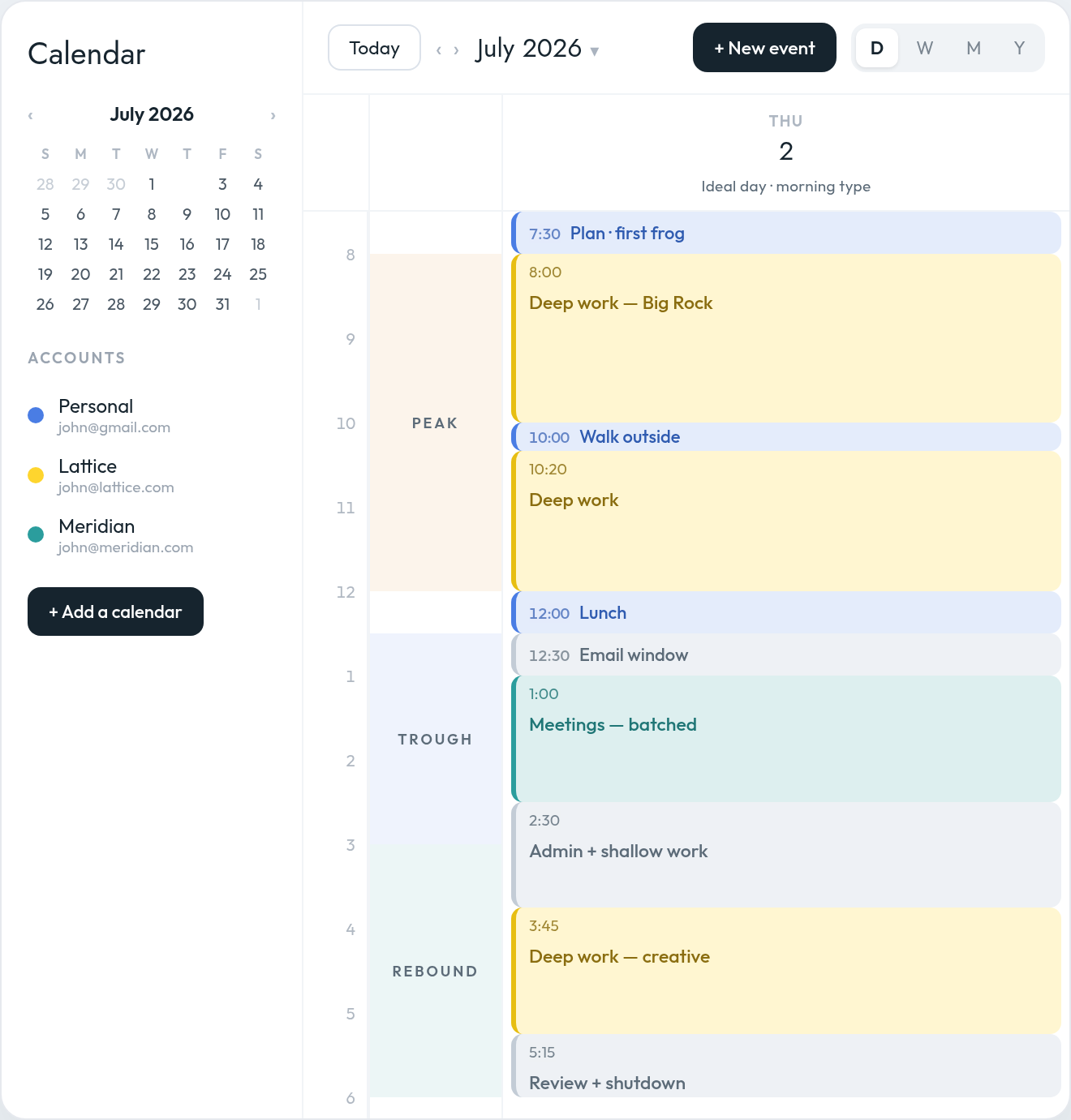
| Time | Block | Rationale |
|---|---|---|
| 7:30–8:00 | Plan the day; first bite of the frog | Fresh mind, low friction |
| 8:00–10:00 | Deep work 1 (the frog / Big Rock) | Peak vigilance (Pink) |
| 10:00–10:20 | Break — walk, ideally outdoors | Attention restoration (Berman/Kaplan) |
| 10:20–12:00 | Deep work 2 | Second ~90-min pulse (Loehr/Schwartz) |
| 12:00–13:00 | Lunch + real disconnect | — |
| 13:00–13:30 | Email window 1 | Batched; trough-appropriate (Kushlev-Dunn) |
| 13:30–15:00 | Meetings (batched) | Protect the morning (Graham) |
| 15:00–15:15 | Buffer / transition | Absorb overrun (ALPEN) |
| 15:15–16:30 | Admin + shallow work (batched) | Trough = routine garbage (Pink) |
| 16:30–17:00 | Email window 2 + shutdown | “Shutdown complete” (Newport) |
An example themed week (multi-venture founder)
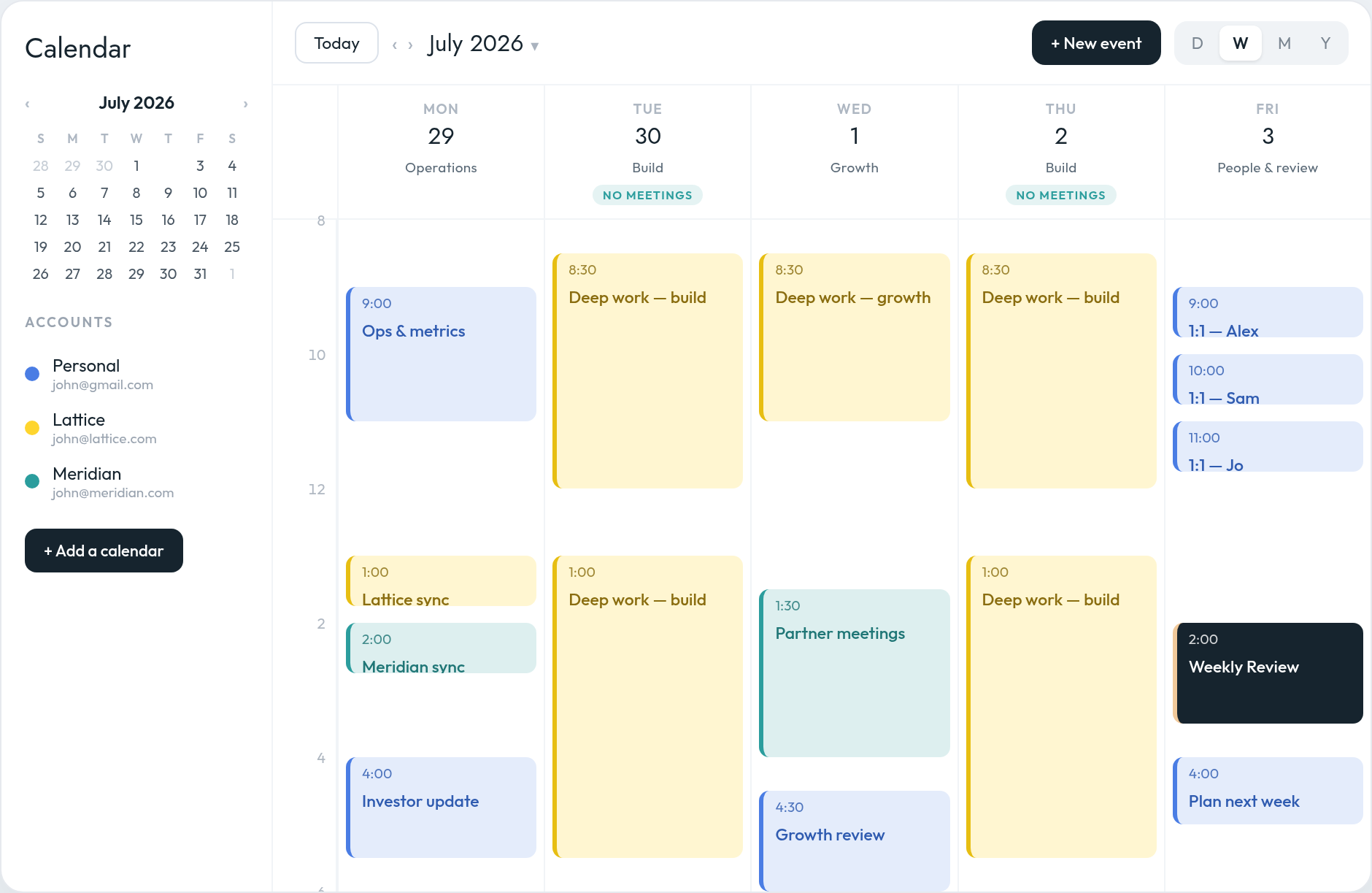
| Day | Theme | Meeting policy |
|---|---|---|
| Monday | Company / operations across ventures | Team syncs in the afternoon |
| Tuesday | Product / build (deep work) | No-meeting day |
| Wednesday | Growth, marketing, partnerships | External meetings 1:30–4pm |
| Thursday | Product / build (deep work) | No-meeting day |
| Friday | People, culture, review & plan | 1:1s AM; Weekly Review PM |
Owls: shift deep-work blocks toward the evening; put admin in your own morning trough.
Sources
Weekly planning
- David Allen, Getting Things Done (2001; rev. 2015) — GTD Weekly Review checklist
- Cal Newport, Deep Work (2016); The Time-Block Planner (2020) — multi-scale planning
- Michael Hyatt, Free to Focus (2019) — Full Focus Planner
- Stephen Covey, 7 Habits (1989); First Things First (1994) — FranklinCovey Habit 3
- Quartz — the case for planning on Fridays
Prioritization
- Eisenhower’s 1954 WCC address; Quote Investigator — urgent/important
- Leo Babauta, Zen Habits — Most Important Task
- Alex Cavoulacos, The Muse — 1-3-5 Rule
- Todoist — Ivy Lee Method; Inc. — the Buffett 25/5 rule is likely fake
- RICE vs ICE (Intercom / Sean Ellis); ICE — Sean Ellis
- Juran Institute — Pareto Principle
- Brian Tracy, Eat That Frog! (2001) — Brian Tracy; the Twain misattribution
Time-blocking, theming, batching
- Cal Newport — planning every minute; The Time-Block Planner
- Forbes — Jack Dorsey’s day-theming; Mike Vardy, Theme Your Week
- Sophie Leroy, “Attention residue” (2009), OBHDP — citation
- Gloria Mark et al., “No Task Left Behind?” (CHI 2005); debunking the “23:15” figure
Energy, timing, breaks
- Daniel Pink, When (2018) — CNBC summary
- Wieth & Zacks (2011), Thinking & Reasoning — publisher; BPS Digest
- Pomodoro — Francesco Cirillo; DeskTime — the 52/17 rule
- Loehr & Schwartz, The Power of Full Engagement (2003); Schwartz, “Relax! You’ll Be More Productive” (NYT, 2013); Kerkhof et al. — no 1.5-h cognitive rhythm
- Attention Restoration Theory (Kaplan; Berman et al. 2008)
Meetings, email, flexibility, adjusting
- Paul Graham, “Maker’s Schedule, Manager’s Schedule” (2009)
- Asana — No Meeting Wednesdays; Forbes — Shopify’s 2023 meeting purge; CNBC — “Tuesday 2:30pm” (soft)
- Kushlev & Dunn (2015), Computers in Human Behavior — paper (PDF); ScienceDaily
- Kahneman & Tversky, planning fallacy (1979); Thinking, Fast and Slow (2011) — overview
- Lothar Seiwert, ALPEN method / 60-40 rule — Atlassian summary
- Cal Newport, work shutdown ritual; Eisenhower — “plans are worthless” (1957)
A note on unverified claims
- The following are commonly repeated but not independently verifiable, and are flagged in-text: Ivy Lee’s “$25,000” fee; Buffett’s “25-5” pilot story; the “Mark Twain” frog quote; Gloria Mark’s “23 min 15 sec”; the “Tuesday 2:30pm” optimum; Newport’s “2× productivity”; and a clean ~90-minute cognitive work rhythm. Real figures are attributed to their claimants, not presented as established fact.