Founders, independent consultants, and fractional executives rarely have one kind of work.
You may need to spend the morning developing a strategy, the afternoon on client calls, and the evening reviewing hiring plans or financials. You are expected to create, decide, communicate, sell, and coordinate—often across multiple companies, clients, and calendars.
Those responsibilities require two different ways of organizing time:
- Maker time for writing, analysis, strategy, product work, and other tasks that require sustained concentration.
- Manager time for meetings, decisions, communication, reviews, and coordination.
The challenge is not choosing one schedule over the other. You need both.
The challenge is preventing them from constantly interfering with each other.
What is the maker’s schedule?
The distinction comes from Paul Graham’s essay, Maker’s Schedule, Manager’s Schedule.
Managers often divide their days into hourly increments. Meetings, reviews, interviews, and calls can be arranged one after another.
Makers work differently.
Writers, strategists, designers, developers, researchers, and analysts often need longer, uninterrupted blocks. Complex work takes time to load into the mind, explore, and develop.
For a founder, consultant, or fractional executive, maker work might include:
- Writing a client strategy
- Designing a product workflow
- Preparing a board or investor narrative
- Analyzing customer research
- Building a financial model
- Developing a proposal
- Producing a major presentation
- Solving a difficult operational problem
These tasks are difficult to complete in scattered 30-minute gaps.
A two-hour block is not merely four times as useful as four separate 30-minute blocks. In many cases, the uninterrupted block is the only one that produces meaningful progress.
What is the manager’s schedule?
Manager time is organized around coordination.
It includes:
- Client calls
- Team meetings
- One-on-ones
- Candidate interviews
- Sales conversations
- Project reviews
- Partnership discussions
- Approvals and decisions
- Investor or advisor meetings
These activities fit naturally into calendar slots. One call can end at 2:00 and another can begin immediately afterward.
That is why a meeting that looks harmless on a manager’s calendar can be highly disruptive to someone doing maker work.
Distance sharpens this. When a team spans several time zones, the only slots that overlap are often the edges of somebody’s day — precisely the hours a maker was relying on. Scheduling meetings across time zones covers how to distribute that cost deliberately instead of letting it always land on the same person.
Why a single meeting can break a morning
Imagine that you have an open morning from 8:30 a.m. until noon.
That gives you three and a half hours to prepare a client strategy, write a proposal, or work through a difficult product decision.
Now place a 30-minute meeting at 10:00 a.m.
You technically still have three hours available, but you no longer have one continuous block. You have:
- 8:30–10:00
- 10:30–12:00
The meeting may require preparation beforehand and follow-up afterward. You may also avoid starting your most demanding task because another commitment is approaching.
This is why calendar fragmentation is so expensive. A meeting does not consume only the time displayed on the invitation. It affects the usable time around it.
For someone managing several calendars, the problem becomes even worse. A personal commitment on one calendar, a client call on another, and an internal team meeting on a third can quietly divide the entire day into unusable fragments.
Most founders and consultants are both makers and managers
The distinction is useful, but most people do not belong permanently in one category.
A founder operates as a maker while:
- Developing strategy
- Designing the product
- Writing a fundraising narrative
- Reviewing customer research
- Thinking through a major decision
The same founder becomes a manager while:
- Running a leadership meeting
- Interviewing candidates
- Meeting investors
- Reviewing performance
- Coordinating across teams
Independent consultants and fractional executives face the same tension.
Producing client work requires maker time. Managing stakeholders, selling engagements, handling email, and attending calls requires manager time.
When you work across several companies, each client may assume your availability is flexible. Without clear scheduling boundaries, your week can become a collection of isolated meetings with no room left to do the work those meetings create.
The goal is not to eliminate one mode. It is to separate them deliberately.
The worst approach: mixing both modes all day
A fragmented calendar can feel productive because it is full.
You answer email at 8:30, work on a proposal at 9:00, take a call at 9:30, return to the proposal at 10:15, review a document at 11:00, join another meeting at 11:30, and try to restart the proposal after lunch.
You remain busy all day but rarely stay with one important problem long enough to finish it.
This creates three costs.
Repeated context switching
Each transition requires you to reconstruct what you were doing, what you had decided, and what should happen next.
Anticipatory distraction
An upcoming meeting can make the preceding block less useful. Even with 45 minutes available, you may hesitate to begin something difficult because you know you will soon need to stop.
Shallow work expands
When the calendar is fragmented, email, Slack, quick reviews, and administrative tasks become the easiest ways to fill the gaps.
These activities may be necessary, but they can consume the day while the most valuable work remains untouched.
A better model: separate maker time from manager time
Instead of switching continuously, assign different parts of your week to different modes.
During maker time, you produce, analyze, write, design, or solve.
During manager time, you communicate, coordinate, review, and decide.
This separation can happen at several levels.
Option 1: Maker mornings, manager afternoons
For many people, the simplest structure is:
- Morning: maker schedule
- Afternoon: manager schedule
For example:
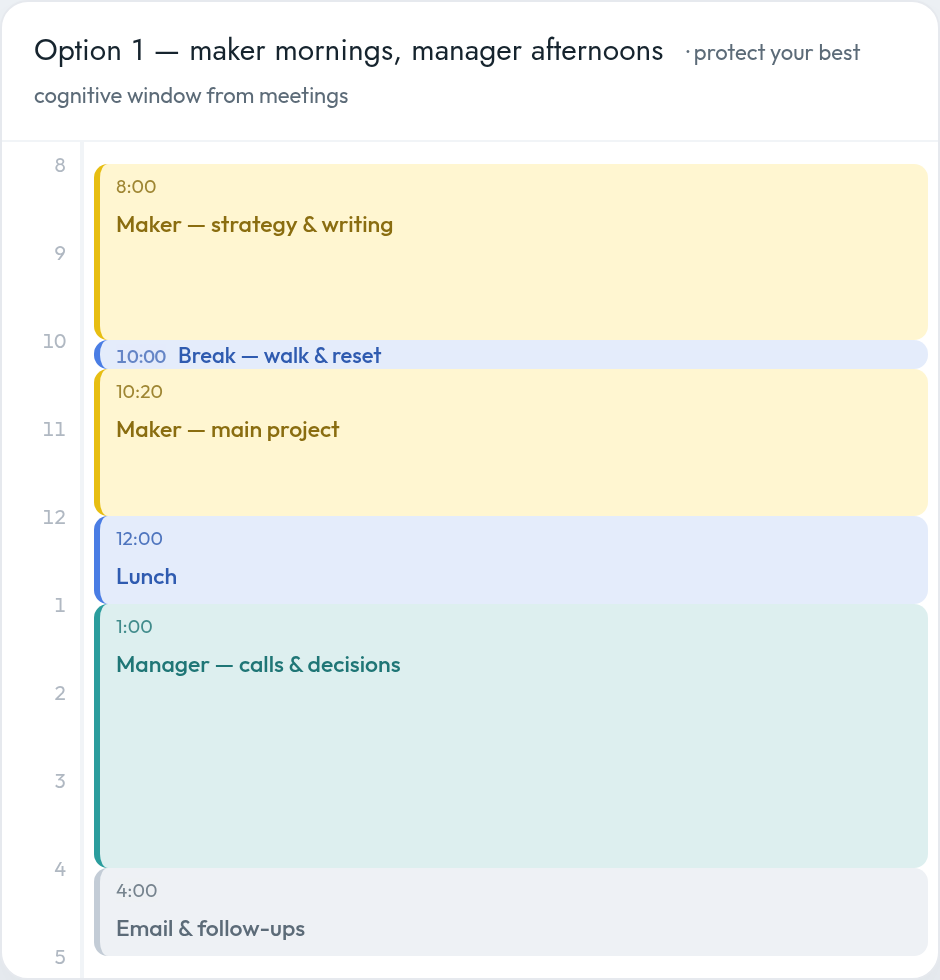
This works well for people whose concentration is strongest in the morning.
A night owl might reverse the pattern. The exact hours matter less than protecting your best cognitive window from meetings.
Option 2: Maker days and manager days
Some work needs half a day or more.
In that case, separate the modes by day.
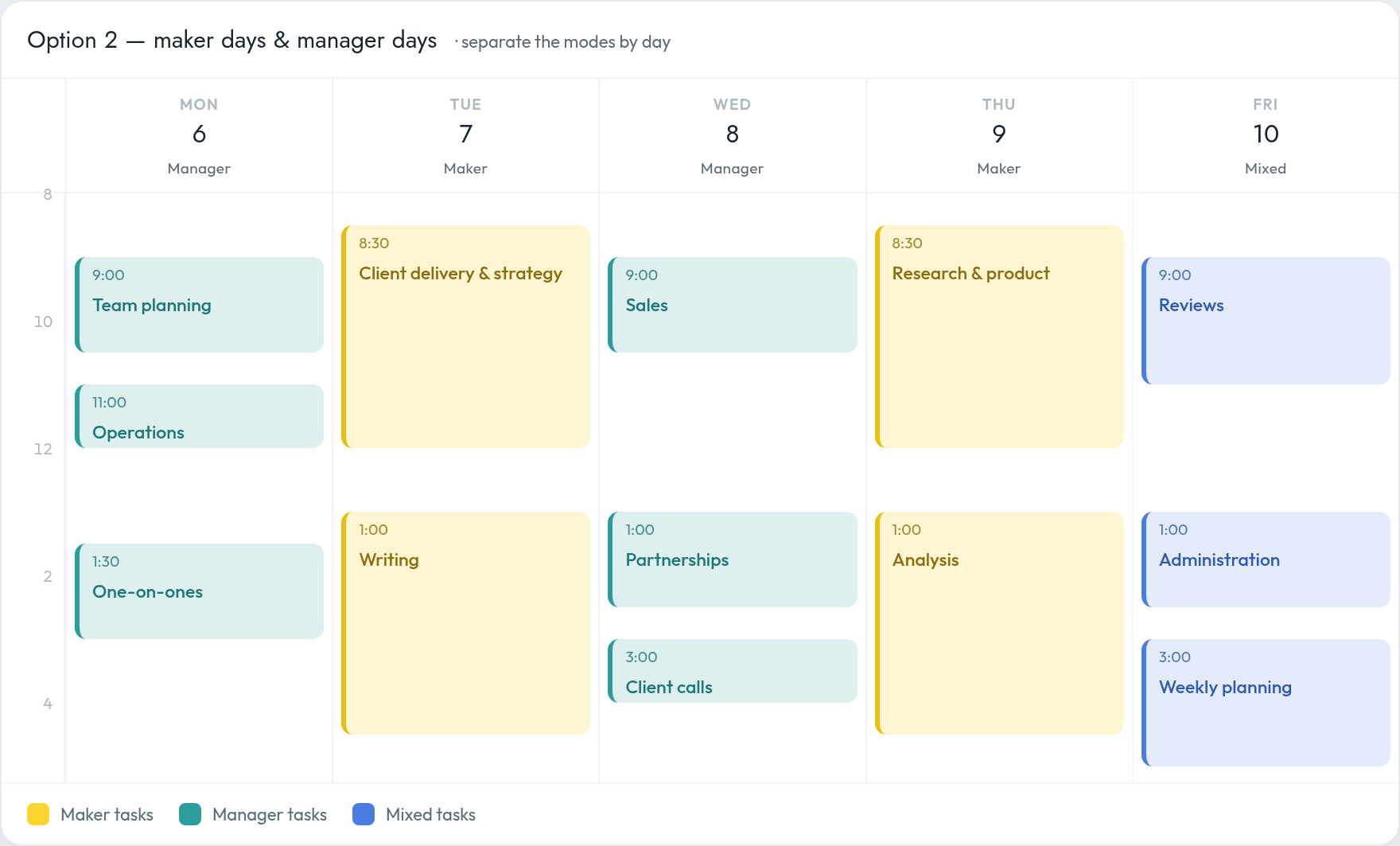
This structure is especially useful when you serve several clients.
For example:
- Monday for internal company work
- Tuesday for Client A delivery
- Wednesday for calls across all clients
- Thursday for Client B delivery
- Friday for sales, administration, and weekly planning
The important point is that each client or company should not be allowed to claim random pieces of every day.
Option 3: Half-day themes
A full meeting-free day may be unrealistic. Half-day themes offer more flexibility. When several companies compete for the week, calendar theming for founders develops this into a full system.
For example:
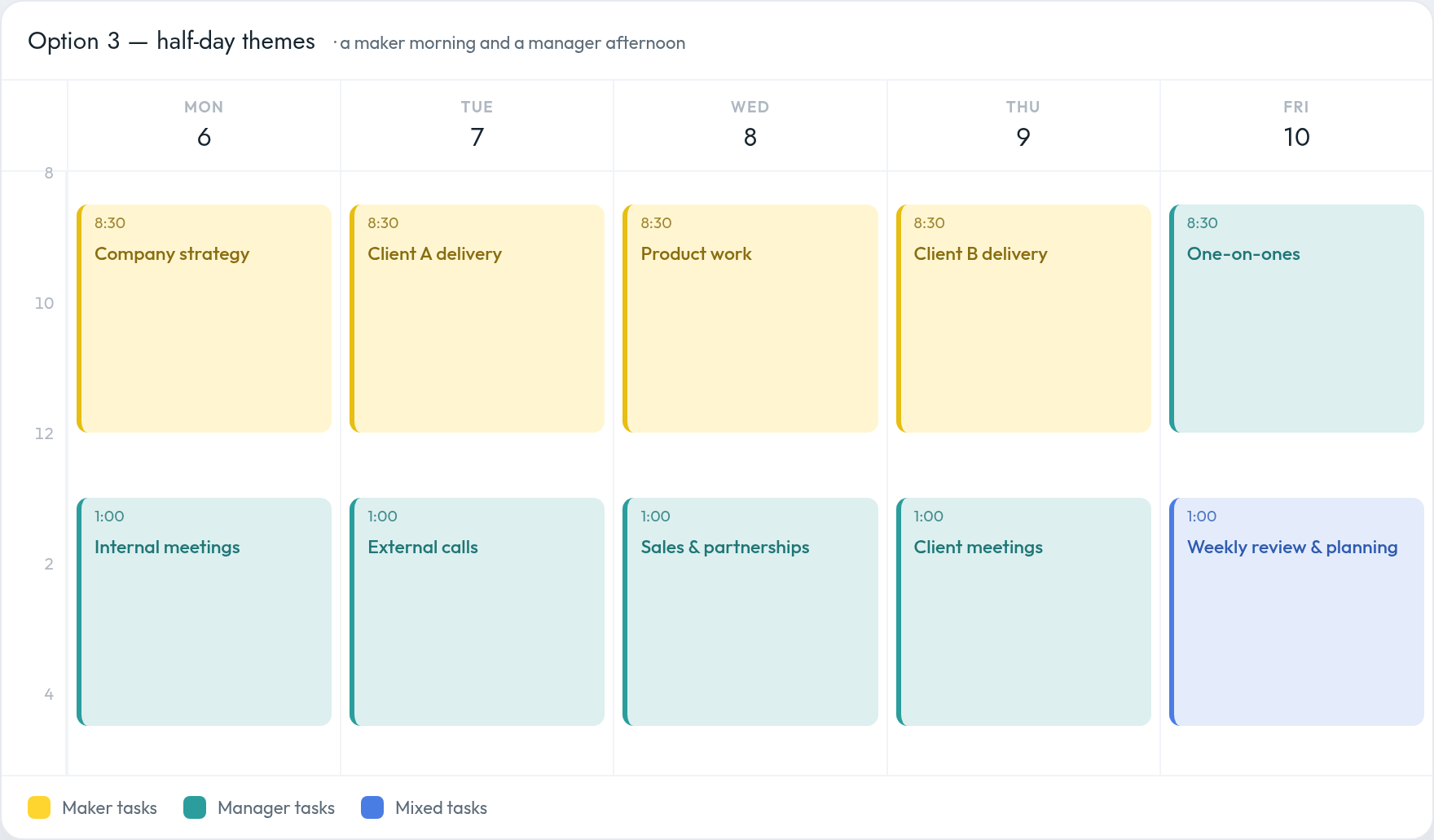
This preserves meaningful maker blocks while still providing several meeting windows.
It also makes scheduling easier because you can direct each type of meeting toward a predefined part of the week.
Schedule maker time before meetings
If maker time is added only after everyone else has chosen their meeting slots, it will rarely survive. For how to block it without overfilling the day, see how to time-block your calendar without overplanning.
During your weekly planning process:
- Identify the two or three most important outcomes for the week.
- Decide which ones require sustained concentration.
- Schedule those blocks first.
- Open the remaining windows for meetings.
- Leave some uncommitted time for overruns and unexpected work.
Do not block “deep work” without defining the outcome.
Use specific calendar titles such as:
- Draft Client A growth strategy
- Finalize investor update
- Review customer research
- Build Q3 financial model
- Write product requirements
- Prepare leadership offsite
A broader system for prioritizing work, time-blocking it, matching tasks to energy, and leaving sufficient calendar slack is covered in Planning Your Week and Managing Your Calendar: A Research-Grounded Field Guide.
Batch meetings instead of scattering them
Three consecutive meetings from 1:00 to 3:30 are usually less disruptive than the same meetings spread across the day.
Batching meetings:
- Preserves larger blocks elsewhere
- Reduces context switching
- Concentrates preparation and follow-up
- Creates predictable availability
- Makes meeting-heavy days easier to plan
You might create recurring windows such as:
- Monday and Wednesday, 1:00–4:00 p.m.
- Tuesday and Thursday after 3:00 p.m.
- Friday morning for one-on-ones
- Two weekly blocks for external calls
The narrower the windows, the more likely meetings are to cluster.
Manage precedence across multiple calendars
For people with several workspaces, one of the hardest problems is deciding which commitments should take precedence.
You may have:
- A personal calendar
- A company calendar
- One calendar for each client
- A separate scheduling calendar
- Calendars shared by assistants or team members
Without clear rules, every calendar may appear equally available, leading to conflicts or excessive blocking.
Define explicit precedence rules.
For example:
- Company leadership meetings override optional personal events.
- Client delivery blocks cannot be booked over without approval.
- Personal events remain visible but are marked as free when work calendars should take precedence.
- One calendar acts as the primary source of availability.
- Travel time and on-site meetings block all calendars.
- Tentative events do not block external scheduling.
These rules reduce the amount of manual calendar management required each week.
Use an AI scheduling assistant to enforce the structure
An AI scheduling assistant like Everest is built to help maintain these boundaries across multiple calendars.
The key is to think in concrete rules rather than asking it to “protect focus time” in general.
For example:
Keep every Tuesday and Thursday morning from 8:30 a.m. to noon free from meetings for client delivery work.
Only offer external meeting times on Monday, Wednesday, and Friday afternoons.
Cluster all calls into consecutive blocks whenever possible. Do not place an isolated 30-minute meeting in the middle of an otherwise open morning.
Leave at least two uninterrupted two-hour blocks on my calendar each week for strategic work.
Do not schedule meetings between two maker blocks if doing so would divide them into fragments shorter than 90 minutes.
For every on-site meeting, add a 30-minute buffer before and after the event.
Treat Client A’s calendar as unavailable on Tuesdays and Client B’s calendar as unavailable on Thursdays.
Mark personal calendar events as free so that my work calendars take precedence, except for events labeled Family, Medical, or Travel.
Schedule internal meetings before external meetings when both compete for the same window.
Do not offer a meeting time unless it is available across my personal calendar, company calendar, and the calendar associated with that client.
When moving a meeting, preserve the maker block around it rather than choosing the first available gap.
If my week has fewer than six hours of uninterrupted maker time remaining, do not accept new optional meetings without asking me.
The important point is that the assistant should not simply locate empty slots.
It should understand the intended architecture of your week.
An open space is not necessarily available. It may be the only period in which the work created by all those meetings can actually get done.
Protect the edges of maker blocks
A two-hour focus block surrounded by calls may not provide two useful hours.
Add a short buffer before the block to prepare, gather materials, and close communication tools. Add another afterward to capture next steps before changing modes.
For example:
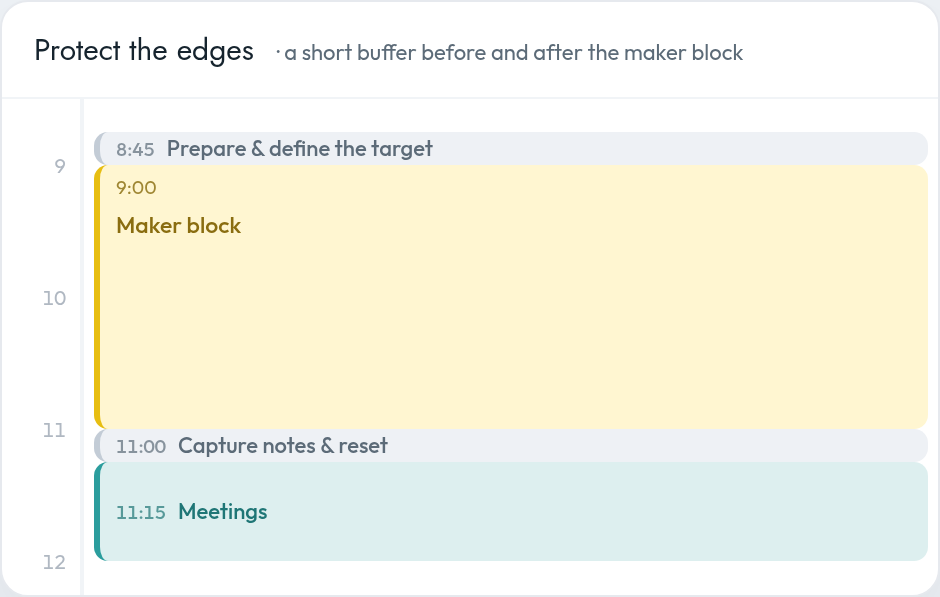
This is particularly useful when moving between different clients or companies. The buffer gives you time to unload one context before entering another.
Reduce unnecessary manager work
Balancing the two schedules becomes easier when fewer meetings are required.
Before accepting a meeting, ask:
- Does this require a conversation?
- Could the information be shared asynchronously?
- Is a decision actually needed?
- Who truly needs to attend?
- Could this be added to an existing meeting?
- Can it be shortened to 25 or 50 minutes?
- Does it need to recur?
The objective is not to eliminate meetings. It is to reserve them for work that benefits from synchronous interaction.
What to do when the schedule breaks
A client emergency, investor request, or urgent team issue may displace a maker block.
The goal is not perfect adherence. It is rapid recovery.
When a block is lost:
- Decide whether the work remains important.
- Move it immediately instead of deleting it.
- Find another continuous block, not several small gaps.
- Identify which lower-priority commitment must move.
- Re-plan the rest of the week from the present moment forward.
Your calendar is a statement of intent, not a prediction. Replanning is part of the system.
A practical weekly template
A balanced week for a founder, independent consultant, or fractional executive might look like this:
Monday: Manager-heavy
- Morning: Weekly priorities and operational review
- Afternoon: Team meetings and one-on-ones
- End of day: Decisions and follow-ups
Tuesday: Maker-heavy
- Morning: Client delivery or strategic work
- Early afternoon: Continue the primary project
- Late afternoon: Limited meeting window
Wednesday: Manager-heavy
- Morning: Client collaboration
- Afternoon: Sales, partnerships, and external meetings
- End of day: Email and administration
Thursday: Maker-heavy
- Morning: Strategy, writing, analysis, or product work
- Early afternoon: Second deep-work block
- Late afternoon: Reviews and feedback
Friday: Mixed
- Morning: One-on-ones and unresolved conversations
- Early afternoon: Administrative cleanup
- Late afternoon: Weekly review and planning
The exact pattern should reflect your workload, clients, energy levels, and responsibilities.
The real goal: fewer accidental switches
Balancing maker and manager schedules does not mean dividing the week perfectly in half.
It means knowing which mode you are in and protecting it accordingly.
When you are operating as a maker, preserve enough uninterrupted time to do difficult work properly.
When you are operating as a manager, cluster communication and decisions so they do not fragment the rest of the week.
For founders, consultants, and fractional executives, the greatest productivity loss often comes from letting several companies and calendars compete for every hour.
A well-designed calendar does more than record your obligations. It creates the conditions required for different kinds of work.
Protect the periods in which you make things. Consolidate the periods in which you manage them. Then give your AI scheduling assistant enough specific rules to defend that structure across every calendar you use.